





A Guide to Sarah P. Duke Gardens
Here's everything you need to know to navigate one of the most beautiful botanical gardens in the U.S.
Nestled in the heart of Durham lies Duke Gardens, a 55-acre botanical wonderland where the hum of cars and traffic disappear, birds serenade visitors from treetops and streams flow alongside pathways connecting people to more than 2,500 colorful plant species. Over 600,000 people visit Sarah P. Duke Gardens every year to experience an artful expression inspired by nature and to enjoy hours of discovery, exploration and inspiration. Designed for year-round interest, there's always something beautiful to see at the gardens.

General Information
Location: 420 Anderson St. Durham, NC 27705
On the West Campus of Duke University (adjacent to the iconic Duke Chapel and the campus’ surrounding neo-Gothic architecture)
Hours: Duke Gardens grounds are open daily from 8 a.m. to dusk; the Main Entrance, Parking and Barnes Welcome Center will open 9 a.m. - 7 p.m. March - Octover; Visitor Lobby open 9 a.m. - 5 p.m. year-round.
Admission: Free
Bathrooms: There are bathrooms available at the new Barnes Welcome Center entrance and in the Terrace Gardens and the Asiatic Arboretum, which remain open later in the day.
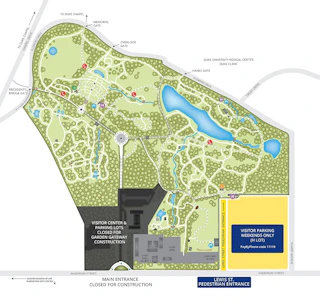
Parking: Main entrance parking is available in the Gardens lot; additional weekend parking will be available in Duke's Campus Drive Lot, which is connected via a walking path.
To pay for parking, you can use the Pay By Phone app and enter location 3109. WiFi is often weak in the parking lots, so it's best to download the app and create your account before heading to the Gardens to speed up your parking purchase.
Food: The new Gardens Café at the Barnes Welcome Center offers grab-and-go food items and drinks that guests can enjoy at expanded indoor and outdoor seating.
The Terrace Café is located in the Bartter Family Terrace House. The menu varies but usually includes a variety of salads, sides, sandwiches, cold beverages, coffee, snacks, ice cream and gluten-free options. The café closes each year in mid-November for the winter season and typically reopens in late March.
Pets: Dogs are welcome in the gardens before 10 a.m. and must be on a non-retractable leash that's 6 feet or shorter. Dogs are not permitted in the Blomquist Garden of Native Plants, Charlotte Brody Discovery Garden, buildings and posted areas. Read the full dog policy.
The Barnes Welcome Center
Over the last year, Sarah P. Duke Gardens has undergone a $30 million renovation called the Garden Gateway project that is transformative to the already amazing visitor experience. Now that it has completed, guests have access to the reopened main entrance at 420 Anderson Street and a totally new visitor experience.
The centerpiece is the new Barnes Welcome Center featuring a café, a dedicated visitor lobby, gallery space, indoor and outdoor classrooms and expanded outdoor gathering areas. The Doris Duke Center has also been fully renovated with enhanced facilities for events, classes and community programs — including weddings. New expanded green spaces throughout the grounds offer more room to gather, relax and take in the scenery, and the redesigned entrance improves accessibility and wayfinding for all visitors, including a dedicated school bus drop-off.

The Adventure Begins
After you pass through the welcome center and pick up a map and visitor guide to assist you in your walk through the various gardens, you'll make your grand entrance into the gardens through the famed Cherry Allée. A crown jewel of the gardens, the Akebono cherry trees bloom each March, a spectacle that attracts thousands of visitors each day during peak bloom.
Once you enter through the Allée, the stunning Rose Garden and Roney Fountain await, with divided paths leading you to the various gardens available to explore.
Consult your color-coded map for directions through the Historic Gardens and Terraces, the H.L. Blomquist Garden of Native Plants, the W.L. Culberson Asiatic Arboretum and the Doris Duke Center & Gardens — the four main areas of Sarah P. Duke Gardens. All of these stunning areas have diverse and colorful flowers and plants for you to explore.

W.L. Culberson Asiatic Arboretum
If you turn right from the Rose Garden, you'll head towards the W.L. Culbertson Asiatic Arboretum. Named for Duke Professor and former Duke Gardens Director William Louis Culberson, the Asiatic Arboretum is an 18-acre collection of plants representing the wealth of floral diversity in Southeast Asia.
As you explore the Arboretum trails, you'll find many garden favorites — Japanese maples, irises, peonies, ginger lilies and cherries — as well as a host of less familiar but equally interesting and ornamental species. Hidden in this area, you will also find one of the nicest Japanese-style bathrooms. (You should check it out even if you don't need to use the bathroom!) Stop by the Pine Clouds Mountain Stream, a dramatic new Japanese Garden, featuring a recirculating stream and waterfalls, and make sure to walk across the Meyer Bridge, a popular arched bright red bridge surrounded by bamboo.

Doris Duke Center and Gardens
If you make your way back toward the entrance from the Asiatic Arboretum, stroll along the northeastern edge of the gardens, through the Woodland Garden bursting with magnolia trees and peonies to the Charlotte Brody Discovery Garden, where you can learn about organic vegetable and fruit gardening as well as water management through rain gardens. Children will enjoy sitting on tree stumps in the story circle and watching the chickens. Check the garden’s events page to see programs and resources for adults, children and families.
Continue on to find the Virtue Peace Pond, featuring an extensive collection of hardy and tropical water lilies, lotuses and marginal water plants. Inspired by England’s many white-flowered cottage gardens, the Page-Rollins White Garden adjoins the Angle Amphitheater, the setting for many weddings and special events.
As you reach the end of theses gardens, you'll eventually come up on the back entrance of the Doris Duke Center, which has been newly renovated and expanded to host private events like weddings and other celebrations as well as events organized by the gardens. Speaking of events, expanded outdoor space means the return of the popular and beloved Music in the Gardens series.

The Historic Gardens
From the Doris Duke Gardens, you can walk back through the Cherry Allée or back along the lower path to the Rose Garden, which features heirloom roses, ornamental grasses, palms, perennials and succulents. In the center of the garden, you can't miss the iconic Roney Fountain, a stunning garden centerpiece over a century old that was recently painted an exquisite deep green.
Continue walking southwest down the perennial allée to see the famous Terrace Gardens and relax under a more than 80-year-old pergola. The Terrace Gardens’ beds are filled each season with combinations of bulbs, annuals, perennials, ornamental grasses, potted plants and scree gardens. In the summer, the fish pool is filled with hardy and tropical water lilies, and the koi fish are always popular with visitors. Bring lunch and picnic in one of the wide-open green spaces in the Historic Gardens.

H.L. Blomquist Garden of Native Plants
The 6.5-acre H.L. Blomquist Garden of Native Plants is filled with more than 900 species and varieties of regional native plants. Many of them found a home in this garden after approved plant-rescue operations from land-facing development. Dedicated in 1968, the garden honors Professor Hugo L. Blomquist, the first chair of Duke University’s Department of Botany and an authority on Southeastern flora.
Relax quietly by the bird viewing shelter to see a host of bird species attracted to the nearby feeding station. Walk down the new boardwalk, check out the Piedmont Prairie and learn about rare and endangered plants at the Steve Church Endangered Species Garden. Keep your eyes peeled for native carnivorous plants.

You probably won’t be able to visit every extraordinary attraction Sarah P. Duke Gardens offers in one day, and that’s okay. Seasonal plantings ensure that each visit is an entirely new experience, so go ahead a plan another trip!


